
Meeting Patients Where They Are:
How DaVita and Infinite Legacy are Bringing Transplant Education to the Dialysis Chair

Guest Author:
Ieesha Johnson
Executive Director, The Decision Project
Infinite Legacy
A community partnership between Infinite Legacy and DaVita, one of the largest dialysis providers in the United States, is bringing transplant education directly into dialysis centers across Maryland, creating a new model for reaching patients where they already receive care.
DaVita provides life sustaining dialysis, the process of filtering waste, excess salt, and water from a patient’s bloodstream when their kidneys can no longer do so, for patients with chronic kidney failure and end- stage renal disease (ESRD) in dialysis centers located in the United States.
By working alongside dialysis providers, social workers, and community partners, this initiative is helping patients better understand transplantation, address common misconceptions, and build confidence in conversations with healthcare teams.
During one of the very first Lobby Days, we overheard a question:
“If my husband gets a transplant, does that mean he won’t have to do dialysis anymore?”
The question did not come from a patient, but from a spouse who had spent years accompanying a loved one to treatment without ever being told that transplant could mean the end of dialysis altogether. It’s a simple question that revealed a profound information gap.
Since July 2025, Infinite Legacy and DaVita have partnered to help close gaps like this one by bringing transplant education directly into dialysis centers—meeting patients exactly where they are.
Dialysis centers care for many of the patients who need transplant education most, yet opportunities for individualized education can be limited and they are rarely visited by organ procurement organizations (OPO). The barriers patients face go well beyond the clinic walls. Many depend on medical transport just to get to treatments, let alone additional appointments. Complex terminology around transplant, donation, and eligibility can feel overwhelming, discouraging patients from asking questions. And for many communities of color, longstanding inequities and a history of mistreatment in medicine have also contributed to real, earned mistrust.
Janet Somer, a dialysis technician who works alongside our team, sees these challenges every day:
“Misinformation remains a significant challenge, particularly in rural communities and among populations with longstanding medical mistrust. Patients often rely on stories from neighbors, family members, media, or experiences that are decades old. I’ve heard patients express concerns about not having the finances to ‘buy a kidney,’ misconceptions about eligibility, and beliefs that transplant is only available to certain people.”
Janet also sees a barrier that’s harder to measure: fear.
“Many patients have already endured significant loss, disappointment, and uncertainty by the time they arrive to dialysis,” she told us. “I have spoken with patients who refuse to pursue evaluation because they know their child would volunteer to donate, and they don’t want to carry that burden. Others fear rejection, fear they won’t find a match, or fear becoming disappointed. In some cases, it feels as though they are rejecting hope… long before hope rejects them.”
Building a Partnership Around Education
In July 2025, Infinite Legacy and DaVita launched a partnership built to make transplant education more accessible. DaVita designated Infinite Legacy as a trusted community education resource—rather than a vendor—allowing our team to engage patients during their treatment visits in a conflict-free, purely educational capacity.
We call our visits Lobby Days, and the model is simple and replicable.
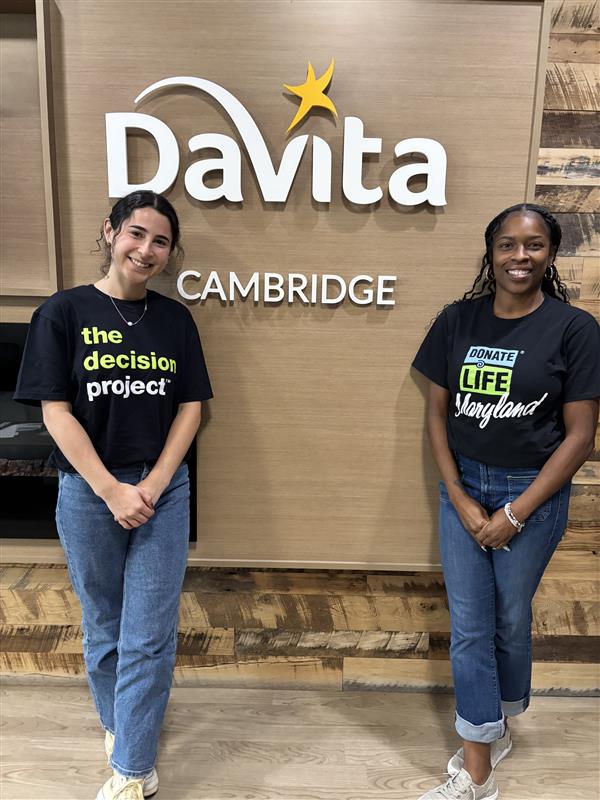
Pictured: (left) Infinite Legacy’s Public Health Coordinator, Naomi Mann, and (right) The Decision Project’s Executive Director, Ieesha Johnson.
Six Principles That Guide Our Approach
-
- Identify high-need locations using service-area demographics and community needs.
-
- Partner early with dialysis facility administrators and social workers.
-
- Build relationships with staff first, recognizing that trust with the care team often comes before trust with patients.
-
- Show up consistently through monthly visits so patients start to recognize our team over time.
-
- Keep it accessible. Plain language, one-on-one conversation, meeting people where they are emotionally as much as informationally.
-
- Track engagement and adapt, using every patient interaction and staff feedback to shape the program and identify where to expand next.
The initiative was launched at three DaVita centers on Maryland’s Eastern Shore—Chestertown, Cambridge, and Easton—and expanded in 2026 to five locations, including its first urban site in Baltimore City.
Early Results
From July 2025 through June 2026, the team reached 564 patients across 24 Lobby Days. Reach has held strong even as the program expanded. During the first half of 2026 alone, the team connected with 279 patients, comparable to the full launch period in 2025, even while adding two new, higher-need sites.
The numbers only tell part of the story.
Facility staff report that more patients are proactively checking whether they’re eligible for the transplant waitlist, and that conversations about transplantation have become more common—not only between patients and staff, but among patients themselves.
Patients have shared comments including:
“These conversations are giving me hope.” and “I feel more confident talking with my doctor about transplantation.”
Janet described what that shift feels like from inside the clinic:
“A buried truth of dialysis is that it’s essentially palliative care. Dialysis clinics can be a dark, depressing atmosphere, with many patients wearing mannequin smiles. In this dark room, every transplant conversation and every Lobby Day is another candle of hope illuminating the darkness. Every question answered, every myth corrected, every fear addressed, and every possibility explored adds a little more light.”
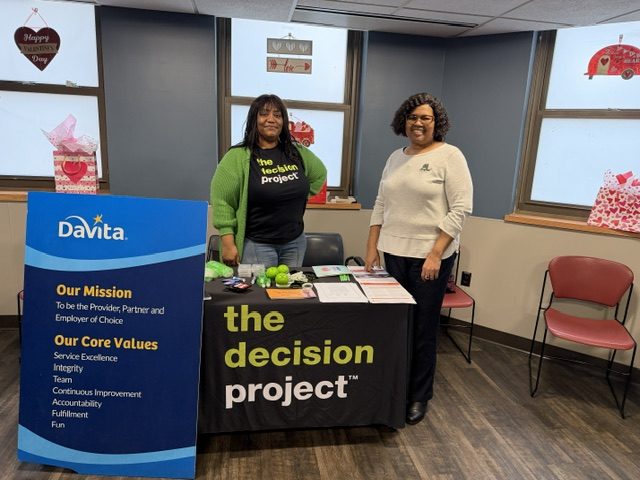
Pictured: (left) Infinite Legacy’s Community Outreach Coordinator, Helen Daniel and (right) Community Outreach Supervisor, Latrice Price.
Looking Ahead
This model does not require a large budget or a new department. It requires a consistent presence, strong partnerships with dialysis providers, and a commitment to meeting patients where they receive care. By using data to continually adapt the approach based on feedback, the program has created a sustainable framework that other OPOs can consider within their own service areas.
This summer, Infinite Legacy is expanding further across Maryland into the Eastern Shore and into Anne Arundel County, while working toward tracking transplant waitlist enrollment directly as a future outcome metric.
By strengthening partnerships across the continuum of care, OPOs can help ensure more patients have access to accurate information about donation and transplantation while supporting informed, patient-centered decision making.
Every person receiving dialysis deserves the opportunity to learn about transplantation, ask questions, and have informed conversations with their healthcare team. Meeting patients where they are can help make those conversations happen earlier, more consistently, and with greater confidence.
Interested in bringing a similar model to your service area? Infinite Legacy and The Decision Project are happy to connect with OPOs and community partners exploring dialysis-based transplant education. Reach out to Ieesha Johnson, MS, Executive Director, The Decision Project.
About the Author:
Ieesha Johnson was a Breakout Session Presenter at the 2026 AOPO Annual Meeting in Orlando, Florida.
Ieesha Johnson is the Executive Director and Founder of The Decision Project®, a grassroots initiative she established under the umbrella of Infinite Legacy to empower socially disadvantaged communities to make informed and inspired decisions about donation and transplantation through culturally grounded education and engagement. She previously served as Director of Community Outreach at Infinite Legacy, leading statewide efforts to increase awareness and address disparities in organ, eye and tissue donation. Ieesha is a former president of the Association for Multicultural Affairs in Transplantation (AMAT), currently serves on the Association of Organ Procurement Organizations’ (AOPO) IMPACT Committee, and previously serve as an expert panelist for the Division of Transplantation within the U.S. Department of Health and Human Services.