
Why Youth Engagement Matters More Than Ever: Lessons from the 2025 Campus Challenge

Organ, eye, and tissue donation has always been rooted in community. Decisions to register are rarely made in isolation. They are shaped by conversations with trusted peers, shared experiences, and opportunities to learn in spaces where people feel seen and respected. As the donation community looks toward the future, grassroots and community-led outreach has never been more important.
Across the country, OPOs continue to invest in education and engagement strategies that meet people where they are. One powerful and often underutilized extension of this work is youth-led advocacy. When students are equipped with accurate information and supported as partners, they bring donation education directly into classrooms, student organizations, and everyday conversations. This peer-to-peer approach creates space for trust, curiosity, and thoughtful decision-making.
At SODA: Student Organ Donation Advocates, our mission is built on this belief. We support high school, undergraduate, and graduate or professional students as they lead donation education and registration efforts within their own communities. By centering peer-to-peer engagement, SODA helps translate the life-saving mission of organ, eye, and tissue donation into conversations that feel personal, accessible, and relevant.
Our 2025 Campus Challenge offers a clear example of how grassroots, student-led outreach can drive meaningful impact when paired with strong OPO partnerships.
The Power of Student-led Advocacy
Students occupy a unique position in donation advocacy. They are not speaking at their peers, but with them. They share classrooms, residence halls, student organizations, and lived experiences. That proximity matters.
Public health research has long supported this approach. In his study titled “Racial and ethnic differences in students’ attitudes and behaviors toward organ donation,” Arthur J. Rubens, DrPH, emphasized the importance of educational outreach in academic settings, noting that “[schools] are ideal environments to provide information and education regarding organ donation. The students in universities are a ‘captive audience’ that are receptive to education.”
Receptive does not mean passive. Students ask thoughtful questions. They challenge misinformation. They want to understand how systems work and where they fit within them. When they lead donation education efforts, those conversations become more nuanced and more credible.
Dr. Rubens also underscored the power of peer-to-peer advocacy, writing that “the strongest correlates to signing an organ donor card were support of the concept of organ donation, having knowledge of the organ donation system, and having personal experience of knowing someone who had signed an organ donor card or received an organ transplant.”
Student leaders see this play out in real time.
As Julia Renz, the President of SODA at the University of Colorado Boulder and two-time Campus Challenge College Champion, shared at AOPO’s 2025 Annual Meeting, “It is hearing the stories from individuals who are directly affected that makes the biggest impact.”
When students are willing to be vulnerable and share their lived experiences, donation education becomes human rather than abstract.
SODA’s model is built around these insights. Students are not only trained in the facts of donation, but they are encouraged to share stories, listen deeply, and create spaces where peers can process their decisions without pressure.
The Campus Challenge, at a glance
The Campus Challenge is an annual nationwide initiative that brings together students, OPOs, and national partners to inspire donor registration and meaningful education in school communities. Students plan and execute outreach efforts, host conversations about donation, and engage their peers with honesty, accuracy, and empathy.
In 2025, we hosted the third annual Campus Challenge in partnership with AOPO, the Association for Advancing Tissue and Biologics (formerly the American Association of Tissue Banks), the Eye Bank Association of America, Donate Life Texas, and Second Chance Fundraising. Their support unlocked:
-
-
- Organ, eye, and tissue donation education for 33,642 people.
- 433 new donor registrations.
-
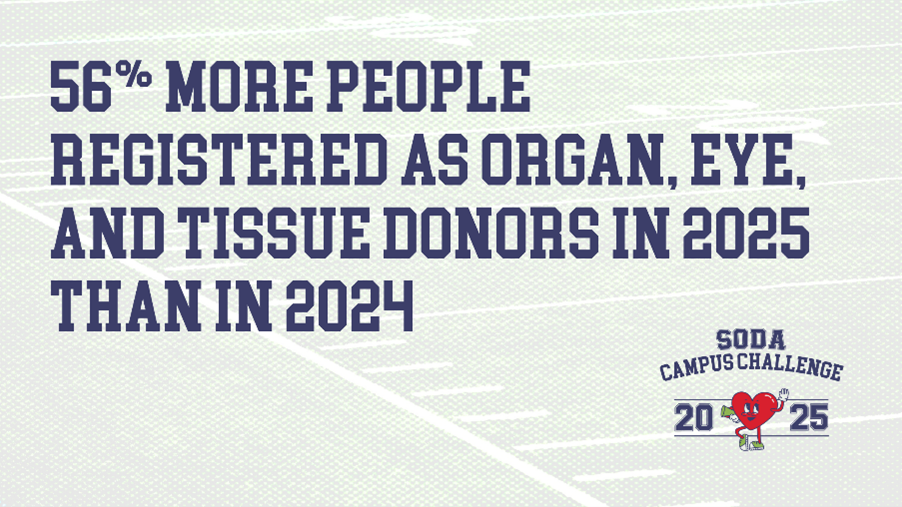
In fact, student teams registered 56% more donors than they did in 2024!
Leadership Through Partnership
SODA’s role in the Campus Challenge is not simply to recruit students or coordinate logistics. Our leadership lies in building the infrastructure that allows students and OPOs to succeed together.
At its core, this partnership works because each group brings distinct expertise. OPOs are the donation experts, grounded in clinical knowledge, community relationships, and regulatory responsibility. SODA, as an organization, is the student expert. We understand how to support students on campus thanks to our experience with 130+ student-led chapters across the country. Together, this combination ensures that student-led efforts are accurate, ethical, and impactful while remaining connected to community and clinical realities.
As Julia noted, “Donor Alliance has been instrumental in our club’s ability to educate and advocate for the transplant community.”
Through training, resources, and relationship-building, OPO partners help ensure students are confident and well-informed.
Julia added, of her chapter’s OPO support, “They provided the tools, training, and resources that allow students like me to become informed, empowered advocates. With this knowledge, we’ve been able to be more informed and more effective in reaching students on campus and beyond.”
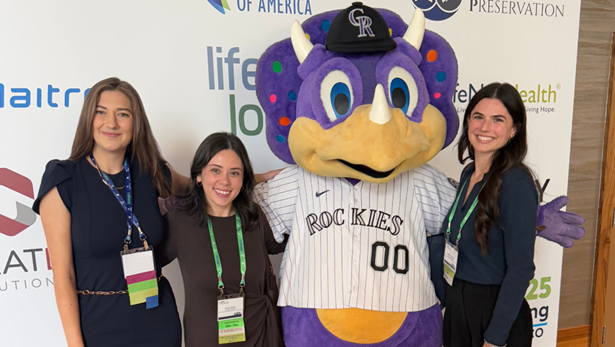
Pictured: Julia Renz, SODA at the University of Colorado Boulder President, Nicole Nidea, SODA Executive Director, Colorado Rockies Mascot, Dinger, Sophia Renner, SODA Engagement Director
Meeting the Moment Together
There is no question that this is a challenging time for donation advocacy. Declining registration rates and complex community dynamics demand creativity, humility, and collaboration. They also demand leadership willing to prioritize education, even when outcomes take time.
The Campus Challenge demonstrates that progress is possible. A 56% increase in registrations year-over-year is not an accident. It is the result of consistent investment in youth leadership and strong partnerships across the donation community.
For OPO leaders, the takeaway is not that students should replace existing outreach strategies. It is that students should be central to them. When young people are empowered with the right tools and trusted as partners, they can help rebuild the foundation of understanding and trust upon which donation depends.
Looking Ahead
As we look to the future, SODA remains committed to working alongside OPOs to expand and strengthen youth education nationwide. We know the work ahead is complex. We also know that the next generation is ready to lead if we are willing to lead with them.
The success of the 2025 Campus Challenge is a reminder that even in difficult climates, meaningful growth is possible. It happens when we invest in people, prioritize education, and choose partnership over isolation.
We are so grateful for our partnerships with OPOs and organizations like AOPO. Together, we can continue building a donation community that is informed, compassionate, and prepared for the future.
To learn more about SODA, visit sodanational.org or email us at hello@sodanational.org
About the Author
Nicole Nidea was first introduced to SODA: Student Organ Donation Advocates in 2015 and has been devoted to educating others about organ, eye, and tissue donation ever since. She helped lead the original SODA chapter at Washington University in St. Louis until graduating in 2019 with a BA in Women, Gender, and Sexuality Studies. Nicole joined the SODA National Team in 2020 as the volunteer Director of Development, spearheading the organization’s fundraising efforts. In April 2021, Nicole became SODA’s first full-time employee and now serves as Executive Director. She leads the national team, cultivates partnerships across the donation and transplant community, and ensures students have the resources they need to save and heal lives. In recognition of her leadership, Nicole was named to The Organ Donation and Transplantation Alliance’s inaugural 40 Under 40 cohort.