
The Value of Validated Performance Metrics for OPOs
For four decades, Organ Procurement Organizations (OPOs) have worked tirelessly to turn the generosity of donors and their families into the gift of life for patients waiting for transplants. As the nation’s federally designated organizations responsible for recovering organs from deceased donors, OPOs play a critical role in saving and improving lives every day. To ensure every opportunity for donation results in lives saved, it’s essential performance across the system is measured accurately, fairly, and transparently.
That’s why the Association of Organ Procurement Organizations (AOPO), along with 53 OPOs, launched the OPO Metrics Project in partnership with Econometrica, Inc. in March 2025. This initiative represents a milestone in AOPO’s ongoing work to strengthen accountability, transparency, and public trust in the nation’s donation and transplantation system.
Why Performance Measures Matter
Performance measures are the data-driven metrics used to assess how well OPOs carry out their mission. These measures reflect how consistently OPOs identify donors, serve families, partner with hospitals, and ensure organs reach the patients who need them most.
Having reliable, validated performance measures is essential because they:
-
-
- Bring transparency to the organ donation process and how outcomes are achieved across the country.
- Strengthen accountability and equity within the system while advancing trust among patients, donor families, policymakers, and the public to ensure it remains lifesaving and world-leading for years to come.
- Drive continual improvement by helping OPOs learn from data and share effective practices.
- Align partners across the transplant ecosystem to work toward shared goals, improve coordination, and ensure every donor’s gift reaches its fullest potential.
-
Ultimately, validated metrics ensure performance assessments are meaningful, accurate, and fair, and that our world-leading system continues to save more and more lives every year.
The OPO Metrics Project
AOPO’s partnership with Econometrica was established to meet an urgent need to develop revised, new or alternative measures for submission to the Centers for Medicare & Medicaid Services (CMS). CMS currently evaluates OPOs using performance metrics established under the 2020 OPO Final Rule. However, many stakeholders, including AOPO, have identified gaps and inconsistencies in those measures that fail to fully reflect the complexity of organ donation and the many factors outside an OPO’s control.
Through the OPO Metrics Project, AOPO is advancing a science-based approach to create validated measures reflecting the realities of OPO operations and the outcomes that truly matter: saving lives through donation and transplantation. Once developed and tested, these measures can serve as tools for both regulatory use and internal quality improvement across OPOs.
A Data-Driven Framework: The CMS Blueprint Measurement Lifecycle
The project follows the CMS Blueprint Measurement Lifecycle, a national framework that outlines how new performance measures should be developed, tested, implemented, and maintained. By aligning with this lifecycle, AOPO and Econometrica are ensuring the project meets the highest standards of scientific rigor and policy relevance.
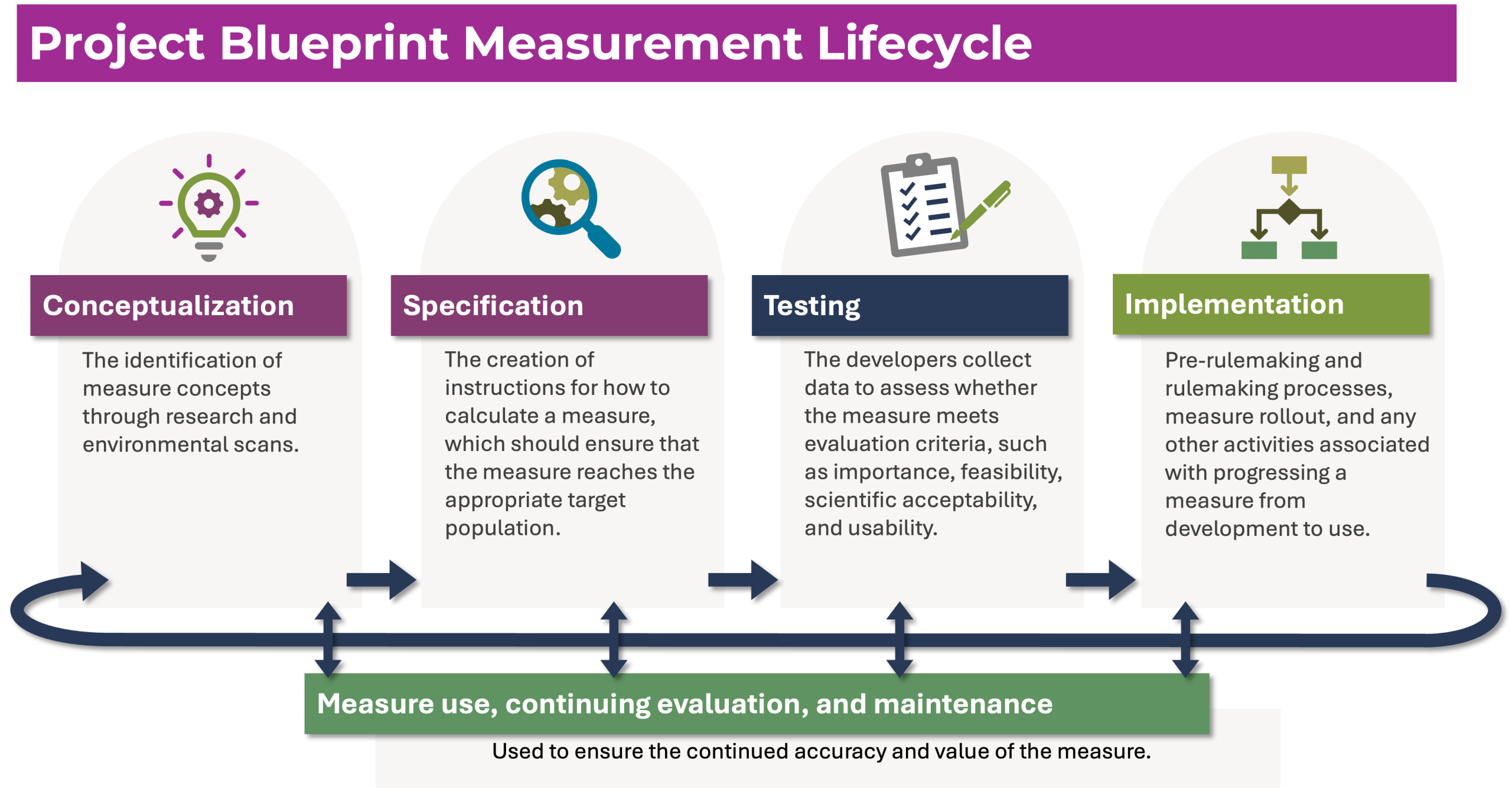
Our version of this process includes four key phases:
- Conceptualization and Specification
The first stage focuses on identifying which performance areas most need improvement. Through research and environmental scans, the project team defines measure concepts and drafts clear instructions for calculation, ensuring each metric captures the right population and process. - Testing
In this phase, measures are pilot tested using real OPO data. The team evaluates each measure against CMS’s criteria — importance, feasibility, scientific acceptability, and usability — to confirm that it accurately reflects performance and can be applied nationwide. - Implementation
Once validated, measures are proposed for endorsement, submitted to CMS, and moved into implementation. If CMS decides to use the measures, this phase can include pre-rulemaking and rulemaking processes, national rollout, and coordination with OPOs to prepare for adoption. Even if CMS does not adopt the measures into rule, the measures can be used by OPOs for quality improvement purposes. - Use, Continuing Evaluation, and Maintenance
The final phase ensures that measures remain relevant over time. Continuous review helps verify that data collection is accurate, definitions remain up to date, and measures continue to drive meaningful improvement.
This methodical approach ensures future OPO performance measures are grounded in evidence, stakeholder input, and real-world feasibility.
Building the Logic Model for OPOs
A highlight of the project is the development of a Logic Model for OPOs, which illustrates how resources, activities, and outcomes are linked throughout the donation process. This model provides a visual roadmap of how OPO performance leads to system-wide impact, from initial donor referral to successful transplantation.
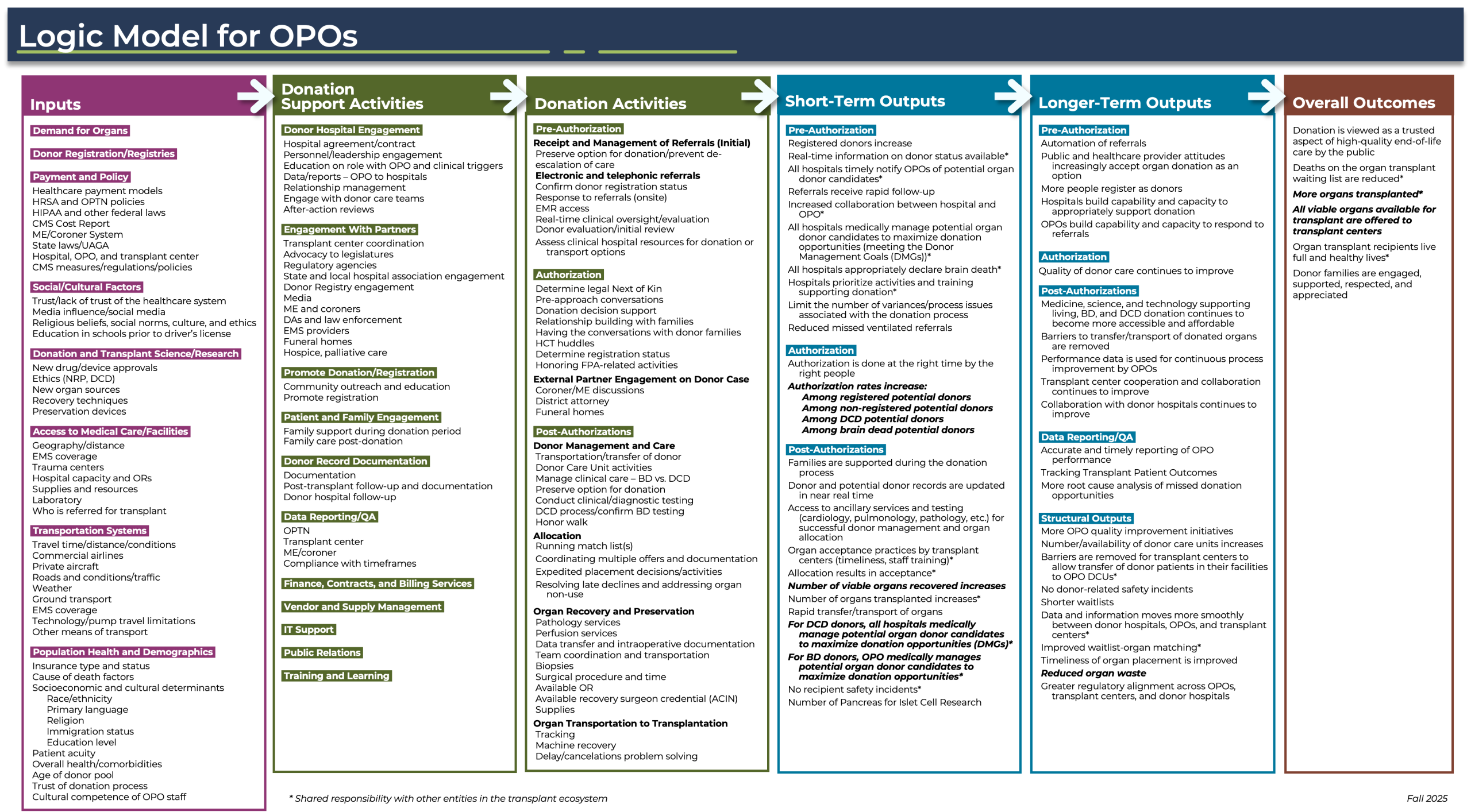
The Logic Model connects inputs such as staffing, technology, and hospital relationships to measurable outputs like donors recovered, organs transplanted, and families supported. By mapping these relationships, AOPO and Econometrica are helping OPOs better understand which factors most influence success and where interventions can drive the greatest improvement.
The Value of Validated Metrics
Validated metrics are not just technical tools, they are the foundation of a stronger, more transparent donation system. For OPOs, they provide a fair and standardized way to evaluate performance across diverse service areas. For policymakers and regulators, they offer confidence that oversight decisions are based on accurate and reliable data. And for donor families and transplant patients, they reinforce trust that every effort is being made to honor the gift of life and maximize outcomes.
Validated measures also help:
- Promote learning across OPOs. When data are comparable, OPOs can share best practices and identify what works across different regions.
- Support continuous improvement. Data-driven insights allow OPOs to target areas where small changes can yield major increases in lives saved.
- Enhance transparency for the public. Reliable, accessible metrics help build understanding of the donation process and confidence in its integrity.
- Encourage collaboration across the system. Shared goals and validated benchmarks strengthen partnerships among OPOs, transplant centers, and federal agencies.
Moving From Development to Action
AOPO’s commitment to developing validated metrics represents a major step forward in modernizing how OPO performance is understood and measured. As the project continues, AOPO and Econometrica will move into the testing phase, collecting data to evaluate the proposed measures and refine them for submission to the measure endorsement process.
By grounding performance measurement in scientific evidence, transparency, and collaboration, this initiative is helping to shape a future where every donor’s gift is maximized, and every patient has a fair and timely chance at a transplant.
As AOPO President Jeff Trageser often notes, “What we measure reflects what we value. When we measure wisely, we improve together.”
Through this project, AOPO and its members are not just measuring performance. They are reinforcing the promise of donation itself and the shared mission to save as many lives as possible.
Thank you,
Steve Miller, MBA, CAE
AOPO CEO
