
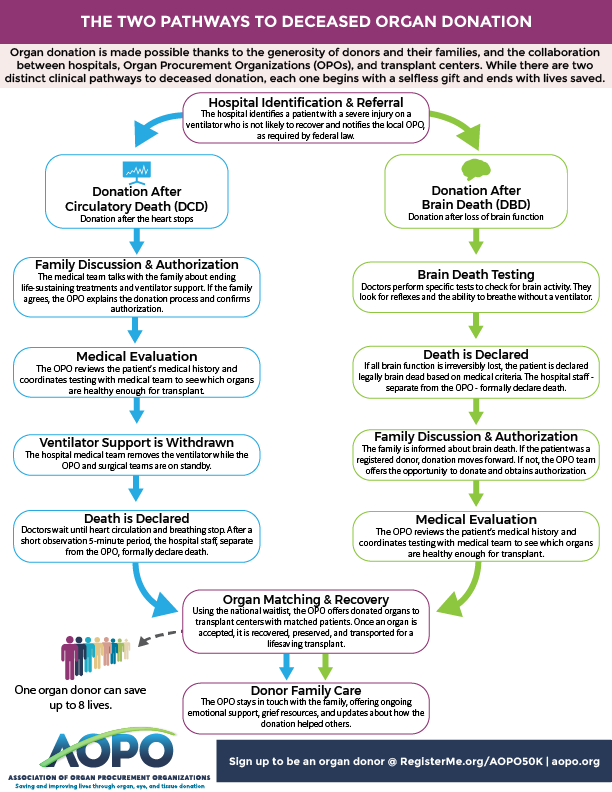
Donation after Circulatory Death (DCD) is one of two clinical pathways for deceased organ donation. It occurs when a patient has a non-survivable injury and does not meet brain death criteria. After the family decides to withdraw life-sustaining treatment, and death is confirmed based on circulatory criteria by hospital staff, the OPO steps in to coordinate the donation process and help save lives.
How the DCD Process Works
Hospital Identification & Referral
The hospital identifies a patient that does not meet brain death criteria, but has a severe injury or illness and is not likely to survive, and notifies the local OPO per law.
The Family Decides to End Life-Sustaining Treatments.
Patient care and end-of-life decisions are made solely by the family and hospital team. If the family decides to remove ventilator support, the OPO can then offer DCD donation and confirm authorization to donate.
Medical Evaluation Takes Place
The OPO reviews the patient’s medical history and coordinates testing with the hospital team to see which organs are healthy enough for transplant.
The Ventilator is Removed
The hospital team removes the ventilator while the OPO and surgical teams are on standby.
Death is Declared
Doctors wait until heart circulation and breathing stop. After a short observation 5-minute period, the hospital staff, separate from the OPO, formally declare death.
Organs are Matched. Lives are Saved.
Using the national transplant waitlist, the OPO offers donated organs to transplant centers with matched patients. Once an organ is accepted, it is recovered, preserved, and transported for a lifesaving transplant.
Ongoing Donor Family Support
The OPO stays in touch with the family, offering ongoing emotional support, grief resources, and updates about how their loved one’s donation helped others.

Organ Procurement Organizations
Organ Procurement Organizations (OPOs) play a vital role in honoring the wishes of donors and supporting families through the organ donation process.
In DCD cases, OPOs are not involved in decisions to withdraw care or in the declaration of death. These decisions are made by the hospital care team. Once donation is authorized, the OPO steps in to coordinate every aspect of the donation — from medical evaluation to organ recovery and matching organs to recipients through the national transplant waitlist.
OPOs also provide continued support to donor families after donation, offering grief resources, updates about transplant outcomes, and ways to honor their loved one’s legacy.
Transplant surgeon and AOPO Medical Advisor-Elect, Dr. Charles Strom, walks through the step-by-step process of Donation after Circulatory Death (DCD), one of the ways organ donation can occur after death.

AOPO DCD Task Force and Guidelines
Donation after Circulatory Death (DCD) has become a cornerstone of modern transplantation and now accounts for approximately half of all organ donors nationwide. As DCD and normothermic regional perfusion (NRP) and normothermic machine perfusion (NMP) activity continues to grow and evolve, it is essential that core ethical, clinical, and legal standards are consistently upheld to preserve donor dignity, protect families, ensure compliance with hospital policy, and maintain public trust in the transplant system.
The AOPO DCD Task Force worked to develop the following guidelines and safeguards to prioritize patient safety, donor dignity, clear communication with the healthcare team and Legal Next of Kin/Donor’s Agent, adherence to hospital policy, and responsible stewardship of organs while allowing thoughtful flexibility based on donor presentation, clinical judgment, and institutional practice.